Websites
HVAC Website Design That Books Jobs
HVAC website design built for conversions: green Core Web Vitals, clean schema, AI-crawlable, live in 2-3 weeks — and you own the site from day one.
Conversion-focused builds for HVAC contractors: green Core Web Vitals, clean schema, readable by AI engines — live in two to three weeks, owned by you from day one.
HVAC Foundry builds HVAC websites for one job: turning searchers — on Google and inside AI answers — into booked calls. A build is $2,500 one-time, or $250/month over twelve months, delivered in two to three weeks. You own the site, the domain, and every account from day one.
Your website is either booking jobs or sending them to the next result
Most HVAC websites fail at the only metric an owner counts: booked jobs. The common failure modes are specific. A slow template that loads after the homeowner has already hit "back." A phone number buried below three screens of stock photos. A site the agency technically owns, so leaving them means starting from zero. And now a newer one: a site built entirely in JavaScript that AI engines cannot read — invisible in exactly the answers homeowners are starting to trust. We built this page's own website as the demo: the site you are reading is the build we sell.
What every build includes
Every HVAC Foundry build ships with the same conversion and technical floor. There is one build at one price, so nothing essential is held back for an upsell.
| Included in every build | What it means for you |
|---|---|
| Conversion layout | Phone number, booking CTA, and service area above the fold on every page |
| Green Core Web Vitals | Built to Google's published "good" thresholds (LCP within 2.5 s, INP under 200 ms, CLS under 0.1, at the 75th percentile) |
| Clean schema markup | LocalBusiness, Service, and Article structured data machines can parse without guessing |
| AI-crawlable rendering | Server-rendered HTML — content readable by ChatGPT, Perplexity, and Google's AI crawlers, not locked behind JavaScript (run the 5-minute test on your current site) |
| Full ownership transfer | Domain, hosting, CMS, analytics — every account in your name from day one |
| Call tracking + form wiring | Leads land in your inbox and CRM, not an agency dashboard you rent |
How the 2-3 week build works
The build runs on a fixed process, not an open-ended "web project."
- Kickoff call (day 1). Services, service area, photos, licenses, the jobs you actually want more of.
- Structure and copy (days 2-7). Page map, service pages, and conversion copy drafted for your review — you approve before anything is styled.
- Design and build (days 7-15). Your brand, your photos, and your service pages applied to the proven conversion layout.
- Technical pass (days 15-18). Core Web Vitals check, schema validation, AI-crawler access test, mobile QA.
- Launch and handover (by day 21). Site live, every credential handed to you, one training call so your team can edit it.
What a build costs
HVAC Foundry publishes its prices — the build price and the payment option are listed here, not saved for a sales call.
| Build | Price | Best for |
|---|---|---|
| HVAC website build | $2,500 one-off | Shops that need a fast, proven, conversion-shaped site with their brand, photos, and service pages |
| Same build, paid monthly | $250/mo × 12 | Shops that would rather spread it over a year — after the twelve months, the site is yours outright |
For market context: Hook Agency — one of the few agencies in this niche that publishes prices, which we respect — lists a templated site at $12K and a custom site at $24K, each split over 12 months, with complex builds up to $50K (verified on their pricing page, August 2026). Their builds carry a bigger team and a longer design process; if you have that budget, they are a legitimate option. Our build exists for the 1-10-truck shop that needs the technical floor above at about a fifth of that published templated price. How Hook and the rest of the field score on transparency, focus, and proof is covered in our head-to-head review of HVAC SEO agencies. Full pricing for everything we sell is on our published pricing page.
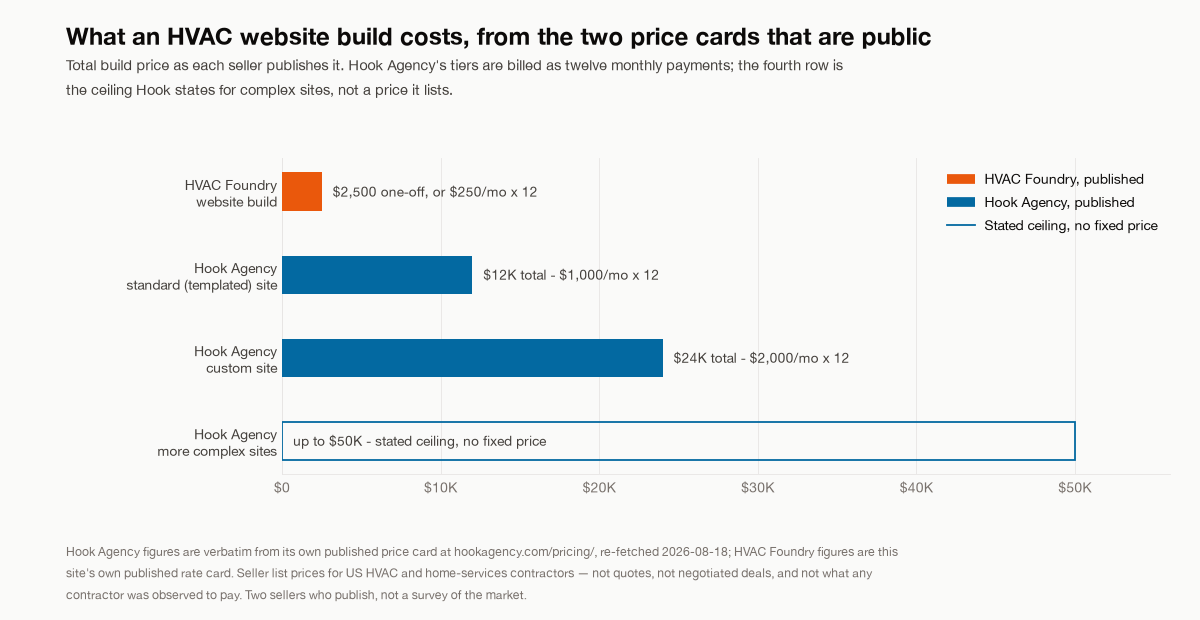
US HVAC and home-services website builds, seller-published list prices re-verified 18 August 2026. Two sellers who publish a price — not a market survey, and not what any contractor was observed to pay.
You own the site — everything transfers
Clients own the site, the domain, and every connected account — from day one, in writing. "Agency-hostage" sites are a real pattern in this industry: the agency registers the domain, owns the hosting, and licenses you the design, so firing them means losing the website. To be fair, this is not universal — Hook Agency, for example, states "you own your website 100%" on its own pricing FAQ. We state the same, and we go one step further: the $250/mo option is a payment plan, not a lease. Stop at month six and you still own what was built; run it to month twelve and the site is yours outright with nothing further owed.
A website alone does not rank itself. Builds pair with our $2,500/mo HVAC SEO retainer when you want the site to climb Google, and with our GEO program — generative engine optimization, meaning visibility inside AI answers, not geography — when you want to measure and grow how often AI engines mention you. Where builds, SEO, GEO, and call answering each fit — and which to buy first — is mapped across everything we run for HVAC companies.
Redesigning an HVAC website without losing the pages customers already find
A new design and a new search structure are different decisions. Your existing AC repair page may already answer a useful local search even if the navigation looks dated. Replacing the layout does not automatically require replacing that page's address, merging it into a general services page or starting on a new domain. When comparing HVAC website design proposals, look for an explanation of what stays, what changes and why each change helps the homeowner's task.
Google separates infrastructure moves with unchanged URLs from moves that change page addresses. That distinction matters when a proposal says “SEO included.” It should be clear whether the work is a visual rebuild, a platform move with the same public addresses, or a change to the pages searchers and other websites already link to. None of those labels guarantees preserved rankings.
Three service paths that should not disappear into one homepage
Consider an illustrative contractor website with these existing pages. The paths are invented to explain the decision, not a client migration or a claim about measured traffic.
| Existing search task | Existing page | What the redesign needs to explain |
|---|---|---|
| A homeowner needs an air conditioner repaired | /air-conditioner-repair/ | Where the repair-specific answer will live, including the actual service and contact route |
| A homeowner is considering replacing a furnace | /heating/furnace-replacement/ | How the replacement decision remains distinct from an urgent repair request |
| A customer wants recurring maintenance | /maintenance-plans/ | Where the plan information belongs, using only the contractor's real current offer |
If the same task and content remain useful, a different color palette is not a reason to invent a new address. If an address genuinely needs to change, the proposal should identify the relevant destination rather than treating the homepage as a universal substitute. Google's move guidance warns that sending unrelated old URLs to one destination can confuse users and may be treated as a soft 404. A successful redirect response alone does not establish that the visitor reached an equivalent answer.
The decision is not “keep every old page forever.” An obsolete offer may have no appropriate replacement, while a genuinely consolidated service may have one useful new owner. Those cases need separate reasoning. Do not approve a blanket merge simply because a smaller sitemap looks tidier.
Choose the pages to protect from evidence, not the new menu
Start with the pages that already attract relevant search visits, have useful links or serve an important customer task. Include supporting resources a new menu might omit, such as an equipment-care explanation or a downloadable document. A page's absence from the navigation does not prove that nobody uses it.
For an HVAC business, timing also changes the picture. A furnace-replacement page and an AC-repair page may have different seasonal exposure. Comparing a winter heating week with a summer cooling week will not isolate the effect of a redesign. Preserve the earlier page and query baseline, then assess the affected tasks after Google has processed the change. The appropriate observation period depends on crawl activity and available evidence; there is no honest promise that every redesign will recover or improve rankings by a fixed date.
This is where a design proposal should connect to the ongoing HVAC SEO work, rather than assuming a new visual layout creates new demand. Better presentation can help a visitor understand a service; it cannot manufacture a service the contractor does not provide.
Make the replacement useful before judging the result
The replacement should still answer the service question, work on a phone and offer a usable next step. Compare the actual rendered repair, replacement and maintenance pages—not only the homepage mockup. Existing job photos, documents and genuine credentials should retain their context where they remain relevant. A faster blank template is not a substitute for the information customers came to read.
For layout and contact-path questions, use our HVAC website conversion guide. For budget and ownership tradeoffs, the website cost guide serves a different decision. Here, the buying question is narrower: can the proposed redesign improve the site while keeping each useful search task intelligible? The answer should be visible in the proposed pages and their relationship to the current site, before a launch is described as an SEO success.
Frequently asked questions
How much does an HVAC website design cost?
HVAC Foundry publishes its prices: $2,500 one-time for a build, or $250/mo over 12 months, after which you own it. Published market comparison: Hook Agency lists $12K templated and $24K custom, split over 12 months, on its own pricing page.
How long does the build take?
Two to three weeks from kickoff to launch. It can extend if design revisions run long or content we need from you arrives late — and we tell you that at kickoff, not at week six.
Do I really own the website?
Yes. Domain, hosting, CMS, analytics, and call-tracking accounts are registered in your name, and the handover of credentials is a launch-checklist item. If you leave us, the site goes with you.
Will the site rank on Google by itself?
No, and be wary of anyone who says otherwise. A technically clean site is the floor — rankings come from ongoing SEO work (content, links, local signals). The build makes that work possible; the SEO retainer does the climbing.
What does "AI-crawlable" actually mean?
AI engines like ChatGPT and Perplexity read your site's HTML the way a browser with JavaScript off would. We server-render every page so the content is actually there — many contractor sites fail this silently. Test your current site in five minutes.
Can you redesign my existing site instead of starting over?
Sometimes. If your current platform can hit the Core Web Vitals and rendering floor, a rebuild on the same domain is cheaper and preserves your history. For a first read, run your current site through our ten-check website grader; then we tell you which path is honest for your situation on the strategy call — including when the answer is "keep what you have."
Get a build quote in one call
Send us your current site through the contact form and we'll set up a strategy call. We look at the site together, tell you what a build would change — or whether you don't need a new site at all — and you get the price in writing before you decide. The build is $2,500 one-off or $250/mo over twelve months, the retainer runs month-to-month, and there is no long-term contract to sign.
See it against your market's numbers.
A 30-minute strategy call with your market's real data. No pressure, no 12-month contracts.